Course 3A: Entity Strategy Foundations™
Prepare for Better Conversations With Your CPA, Attorney, and Financial Advisor
Your CPA understands taxes. Your attorney understands legal structure. Your financial advisor understands how your business fits into your broader financial picture. But you understand the business you’re trying to build. And that matters.
Entity decisions are rarely just about choosing between an LLC, corporation, partnership, or tax election. They can affect ownership, risk, capital, growth, succession, and the options available to you later.
That’s why the most productive professional conversations don’t begin with “What’s the best entity?” They begin with a much better question: “Does my current structure support the business I’m building and where I want to go next?” That’s the question at the center of Entity Strategy Foundations™.
Is This You? Watch the Introduction
Kelly Mattarocci, CPA, MBA — a general introduction to the Course A experience and what you’ll build.
Your Entity Decision Scorecard™
A practical framework you can bring into conversations with your professional advisors — not a certificate of completion.
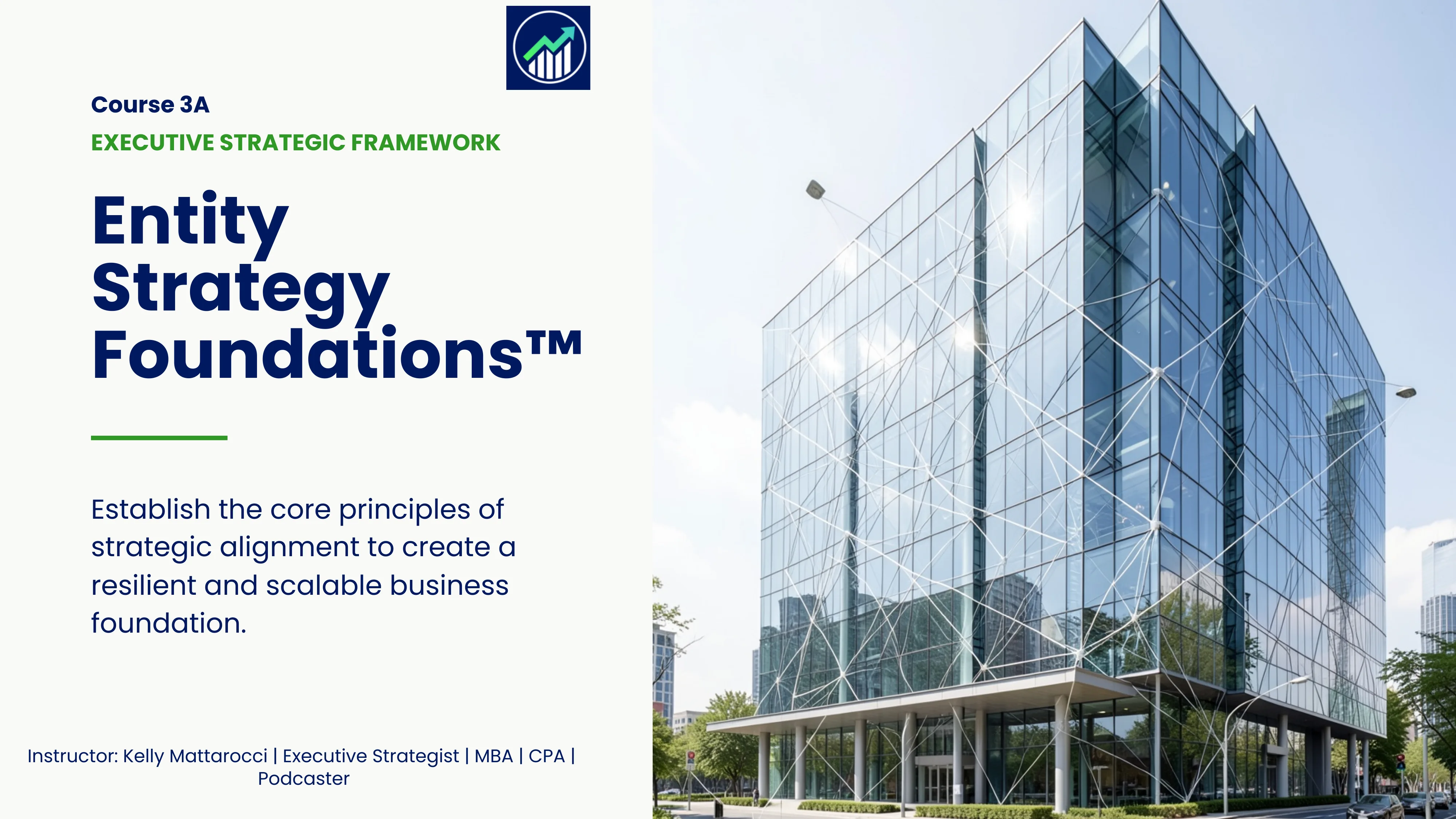
Better Advice Starts With Better Context
Most business owners didn’t start their company thinking about business architecture. They were thinking about customers, revenue, employees, cash flow, and getting the business off the ground. So when it came time to establish an entity, they often accepted the recommendation of a CPA or attorney, signed the documents, and got back to running the business.
There is nothing inherently wrong with that. The problem comes when the business changes but nobody goes back to examine the assumptions behind the original decision.
That’s one of the central ideas introduced in Series 3, Episode 1, The Most Expensive Entity Decision You Never Knew You Made: what begins as paperwork can eventually become business architecture, influencing ownership, financing, flexibility, growth, and future decisions.
Entity Strategy Foundations™ helps you step back and evaluate that architecture before you’re forced to make the next major decision.
This Course Doesn’t Tell You Which Entity to Choose
That’s intentional. Entity Strategy Foundations™ isn’t a substitute for your CPA, attorney, financial advisor, or other qualified professionals — and it isn’t designed to turn you into one. Instead, it helps you become a better-prepared business owner.
You’ll organize the information your advisors need to understand:
- Why your current structure was created
- What assumptions existed when it was created
- What your structure is actually separating today
- How your business has changed
- Where you expect the business to go next
- Where your current structure appears aligned
- Where important questions remain unanswered
- Which issues deserve professional review
The goal isn’t to replace professional judgment. The goal is to make the professional conversation better.
What You’ll Build
This isn’t a course you simply watch. Each module helps you build one part of a practical entity-strategy framework for your business.
Entity Origin Assessment™
Why was the structure created, and what assumptions existed?
Entity Separation Map™
What is your existing structure actually separating?
Business Evolution Profile™
How has the business changed since the original decision?
Future Requirements Matrix™
What might the business need to support next?
Entity Decision Scorecard™
Where does your existing structure appear aligned, and what deserves professional discussion?
How the Course Works
Five implementation-focused modules. Each module is a build step — you leave with a working framework, not a lecture.
Understand the Decision You Already Made
Before deciding what should happen next, understand how you got here. Document your current entity, when and where it was formed, original and current ownership, why the structure was selected, who influenced the decision, what problem it was intended to solve, and which original assumptions are still true today.
Understand What Your Entity Is Actually Separating
Stop looking at an entity only as a tax arrangement. Examine the boundaries it creates around ownership, assets, risk, operations, capital, and investment activities — including who owns and uses cash, equipment, vehicles, real estate, intellectual property, digital assets, and contracts. Visibility comes before strategy.
Does the Structure Still Fit the Business You’ve Become?
Compare the business that existed when your entity was formed with the business you operate today. Examine changes in revenue model, employees, ownership, customers, leadership, assets, capital needs, risk, geography, and business lines — and identify whether the original assumptions deserve another look.
Define the Future You’re Trying to Build
Your advisors need to understand where you’re going. Examine possibilities involving future partners, outside investors, capital needs, family ownership, succession, acquisitions, geographic expansion, eventual sale, and leadership transition. You’re not predicting the future — you’re defining the possibilities important enough to plan around.
Build Your Entity Decision Scorecard™
Bring everything together. Evaluate your current structure across Ownership Fit, Asset Fit, Risk Fit, Growth Fit, Capital Fit, Leadership Fit, Succession Fit, and Future Alignment. Identify your top strengths, constraints, opportunities, unanswered questions, and topics that deserve discussion with your professional advisors.
How to Prepare for Your Next CPA, Attorney, or Financial Advisor Meeting
A professional consultation is more productive when you arrive with more than a question.
Bring Information About Your Current Structure
- Legal entity name and entity type
- State and date of formation
- Current owners and ownership percentages
- Formation documents
- Operating agreement, partnership agreement, bylaws, or other governing documents, as applicable
- Tax elections, if applicable
- Most recent business tax returns
- Current financial statements
- Organizational chart if you have multiple entities
- Information concerning other businesses or entities you own
Don’t worry if you don’t have everything. “I don’t know” is useful information too — it tells you where you need professional help.
Bring the Business Story the Documents Can’t Tell
Your tax return shows what happened financially. Your formation documents show how the entity was established. Neither tells your advisor what you’re trying to build.
What’s changed?
- •Has revenue changed materially?
- •Have you added owners?
- •Has your leadership team changed?
- •Have you hired employees?
- •Have you acquired significant assets?
- •Have your capital needs changed?
- •Has the risk profile of the company changed?
- •Are you operating in new locations or markets?
What’s next?
- •Could you add a partner?
- •Might key employees become owners?
- •Will you need additional capital?
- •Are investors a possibility?
- •Could you acquire another business?
- •Is succession becoming important?
- •Would you like family members to own the business eventually?
- •Could you sell the company?
- •Do you want the business to operate without you?
Ask Better Questions
Preparation isn’t just about bringing documents. It’s about bringing better questions. Instead of asking only “Am I using the right entity?” consider asking:
- “What assumptions are you making about my business when you recommend this structure?”
- “What advantages does my current structure give me?”
- “What limitations should I understand?”
- “How does this structure affect the ownership plans I’ve described?”
- “How could my future capital needs affect this recommendation?”
- “What changes in my business would cause you to reconsider this advice?”
- “What should I be discussing with my other advisors before we make this decision?”
- “What am I not asking that you think I should be asking?”
Don’t Ask Each Advisor to Work in a Vacuum
Entity strategy can cross professional disciplines. A decision that produces a particular tax result may also have legal, ownership, financial-planning, financing, or succession implications.
That doesn’t mean every advisor needs to be involved in every decision. It means you should understand which professional is answering which part of the question.
Your CPA may see one consequence. Your attorney may see another. Your financial advisor may identify an implication for your personal financial strategy. And you, as the owner, are the person connecting those conversations back to the business you’re building.
Entity Strategy Foundations™ helps you organize that conversation.
What You’ll Have When You’re Finished
By the end of the course, you’ll have completed five interconnected tools — culminating in a repeatable evaluation framework you can use in future advisor conversations.
You Don’t Need All the Answers Before You Meet With Your Advisor
In fact, that’s why you have advisors. But there is an enormous difference between walking into a meeting and saying “Tell me what entity I should have,” and walking in saying:
“Here’s why the business was originally structured this way. Here’s how the business has changed. Here’s where we’re going. Here are the areas I’m uncertain about. Help me understand whether the structure still supports that future.”
That’s a better starting point. Because, as Series 3 establishes, the goal isn’t to find a universally “best” entity. It’s to evaluate whether the structure supports the ownership, risk, capital, growth, flexibility, and future objectives of the business you’re actually building.
Bring Better Information to the Table. Ask Better Questions. Make Better Decisions.
Entity Strategy Foundations™
Understand where you are. Define where you’re going. Prepare for the professional conversations that connect the two.
One-time purchase · Lifetime access · 90-day implementation guaranteeEnrollment opening Friday, October 30 at 10 AM CST. The Entity Visibility Toolkit™ will be offered as an add-on during checkout.
Entity Visibility Toolkit™
Move beyond entity selection to see ownership complexity, risk concentration, asset placement, capital readiness, growth constraints, and future flexibility.
Designed for growth-minded business owners who have completed Entity Strategy Foundations™. Offered as an optional add-on during checkout.
Important Note: Entity Strategy Foundations™ is educational and is designed to help business owners prepare for informed conversations with qualified professional advisors. It does not provide legal, tax, accounting, investment, or financial advice and is not a substitute for advice based on your individual circumstances.
Who This Course Is For
Business owners who want to step back and evaluate whether their current entity structure still supports the business they’re building — and who want to arrive at professional consultations prepared for a higher-quality conversation with their CPA, attorney, and financial advisor.
Need a Partner to Deploy It?
If your organization needs practical help evaluating your entity strategy — not just the templates — Market & Margin works with a limited number of companies directly.
Explore AdvisoryStart With the Podcast
Series 3, Episode 1 establishes that entity decisions are business-design decisions. Episode 2 expands that thinking into ownership, assets, risk, capital, growth, and future flexibility. Listen first, then go deeper.
The Most Expensive Entity Decision You Never Knew You Made
Entity selection is often accidental — and the cost shows up years later. Why this is a strategic decision, not a tax decision, and why accountants and attorneys answer different questions.
What Is the Real Job of an Entity Structure?
Stop looking at an entity only as a tax arrangement. Examine the boundaries it creates around ownership, assets, risk, activities, and capital. The intellectual foundation for Course 3A.
Continue the Journey
Course 3A builds entity strategy foundations. Course 3B turns them into a Strategic Entity Architecture™ — an intentionally designed ownership, governance, capital, and growth structure.
Entity Essentials: Know the Rules Before You Grow™
A practical, plain-English understanding of the entity you already have — so you can operate it more intentionally and recognize when a decision deserves a conversation with your CPA or attorney. Build your Entity Owner’s Playbook™.
Explore Course 3BWant to explore the full learning journey? View all courses →
Our Implementation Promise
If you complete the first three modules, submit all required exercises, and can honestly demonstrate that the frameworks did not enable you to gain greater clarity, better decision-making capability, or a more effective operating model, we’ll refund your investment. Complete within 90 days of purchase.