Entity Owner’s Playbook™
You Own an Entity. Do You Actually Know How to Own It?
Forming an LLC, corporation, partnership, or other business entity is one decision. Knowing what you actually own, how its rules affect important transactions, whether it is being operated properly, when changing circumstances deserve another look, and when to involve your professional advisers is something entirely different.
Entity Owner’s Playbook™ helps established business owners build that capability.
You won’t learn to prepare your own tax returns. You won’t learn to become your own attorney. You’ll learn something more useful for an owner: what you should know, what you should verify, what you should monitor, and when you should stop and ask before you act.
By the end of Course 3B, you’ll have built a practical Entity Owner’s Playbook™ for your business and a 90-day roadmap for putting it to work.

From Entity Strategy to Entity Ownership
Entity Owner’s Playbook™ continues the thinking developed in Series 3: What Entity Type Is Best? The series begins with a bigger question than LLC versus S corporation: What is an entity actually supposed to do for the business? An entity exists within a much larger business architecture involving ownership, assets, activities, risk, capital, governance, operations, and future options. That leads to two different owner questions.
Does the entity structure we started with still support the business we’ve built and where we’re going next?
Course 3A helps you evaluate the architecture.
Explore Course 3AOnce the entity exists, do I understand how to own and operate it intelligently?
Course 3B helps you become a more capable owner of the architecture.
Explore Course 3BYou do not need to become an entity expert. You need to understand enough to know what matters, when it matters, and who needs to be involved.
Owning an Entity Is Different From Having One
What should a business owner actually understand about their entity? Enough to make better business decisions. You should be able to answer:
The objective isn’t technical mastery. It’s informed ownership.
Entity Owner’s Playbook™ develops owner recognition and judgment without attempting to turn you into a tax preparer, attorney, bookkeeper, or payroll specialist. That distinction runs throughout Course 3B.
What Should a Business Owner Actually Know About Their Entity?
You don’t need to know everything your CPA or attorney knows. You do need to understand enough about the entity you own to recognize when something matters, know which questions need answers, and involve the right expertise while you still have choices.
Why Isn’t Having a CPA Enough?
Your CPA may prepare your tax returns. Your attorney may maintain legal documents. Your bookkeeper may maintain the accounting records. Your payroll provider may process payroll. All of that may be entirely appropriate.
But delegation doesn’t eliminate ownership responsibility. Someone still needs to understand:
You don’t need to do everyone’s job. You need appropriate visibility into whether the important jobs are actually getting done. Course 3B describes this directly: having professionals perform the work is not the same as having a system that tells the owner whether the work was performed.
What Will You Build?
Your Entity Owner’s Playbook™
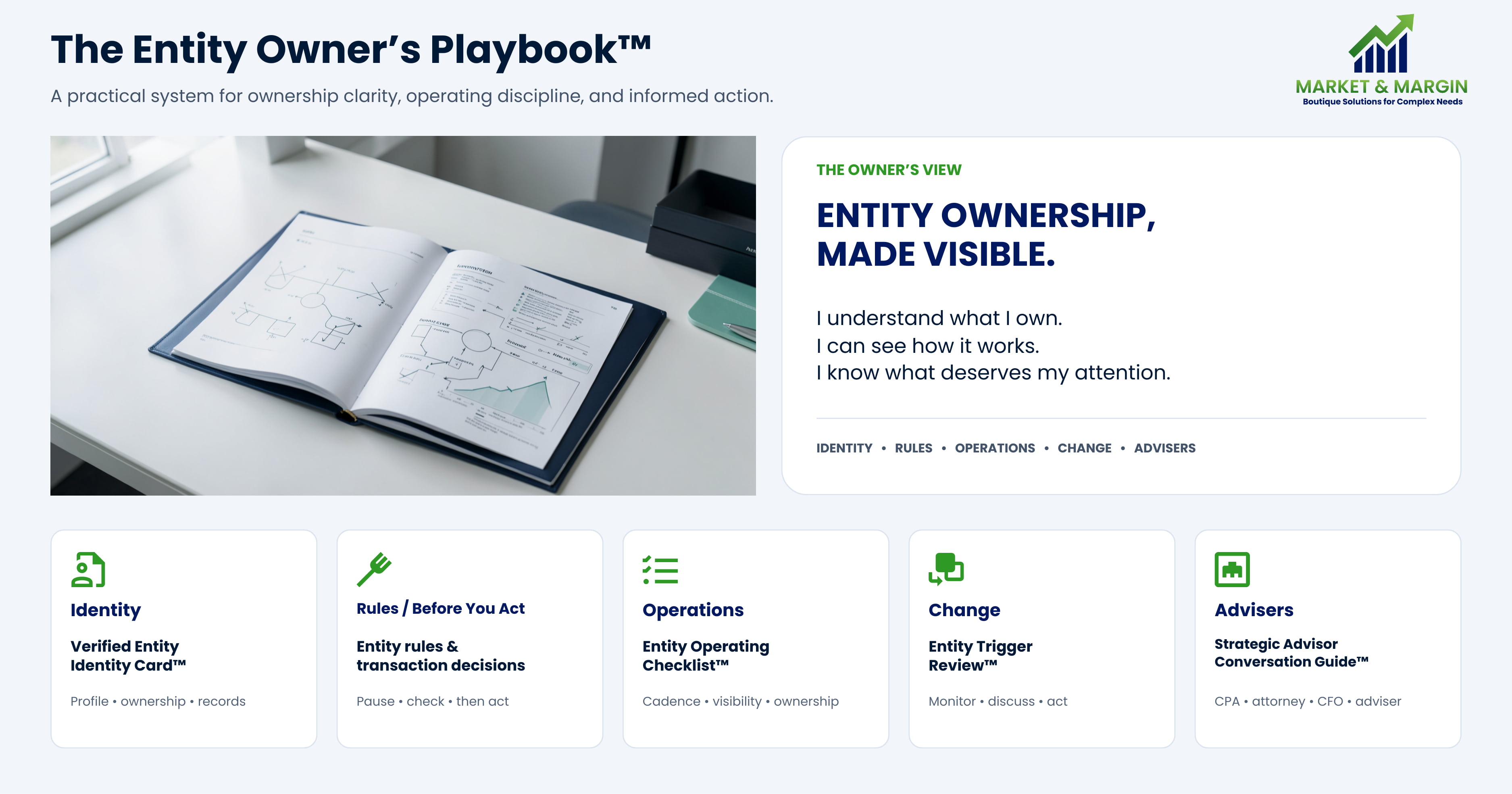
This isn’t a course you simply watch. Each module produces a working component of your Entity Owner’s Playbook™. Together, those components create an owner-level system for understanding, operating, monitoring, and making decisions around the entity you already have.
Included With Your Course
The Entity Owner’s Playbook™ is your primary implementation deliverable and is included in the cost of Course 3B. You build it throughout the five modules. When finished, it brings together:
This is what you build, not simply what you learn.
Designed to Learn Quickly. Built to Implement Over Time.
Course videos are generally less than one hour in total, divided into five focused modules. The real work happens as you apply the tools to your business, so each course includes a 12-week implementation roadmap to guide what to do, in what order, and how to put the system into practice.
Five Modules. One Ownership System.
Know What You Actually Created
What entity do you actually own?
Many owners can name their entity without clearly separating its legal form, federal tax classification, ownership, elections, governing documents, and tax filings. For example, “LLC” and “S corporation” don’t necessarily describe competing things. One commonly describes legal structure under state law; the other can describe federal tax treatment. The same business can potentially involve both concepts. Course 3B begins by separating those facts.
When a fact has legal or tax consequences, uncertainty is not a blank you fill with an assumption. It is a question you verify.
You’ll identify:
Entity Identity Card™
I know what I own.
The Rules That Can Surprise You
When money moves, do you understand what you’re actually doing?
Four owners can each receive $10,000 from their businesses. The bank statements may look remarkably similar. But what actually happened? Was the payment wages, a draw, a distribution, a guaranteed payment, a dividend, reimbursement, loan repayment, or something else? Those terms aren’t interchangeable simply because cash reached the owner. Likewise, selling an asset, lending money to the company, repaying owner debt, changing compensation, or making an unusual distribution can have consequences that depend on the entity, ownership, transaction, basis, asset, history, and other facts. You aren’t going to calculate those consequences yourself. You’ll learn to recognize: “This is something we should understand before we do it.”
Your Before-You-Act List™ identifies significant or unusual transactions that should create a professional conversation before execution, rather than after.
Entity Transaction Map™ + Before-You-Act List™
I know when to stop and ask before I act.
The Same Transaction Doesn’t Always Mean the Same Thing
Two transactions that look economically identical can produce different consequences. The sophisticated owner doesn’t memorize every technical rule. The sophisticated owner recognizes when the rule may matter and asks before acting.
Episode 4: The Hidden Cost of Complexity
When the structure creates more cost, administrative work, management responsibility, and operational friction than strategic value, complexity has become the problem. The larger Course 3B principle: you don’t need to know every technical rule. You need to know enough to recognize when the rule matters before you act.
Listen to EpisodeOperate the Entity You Chose
Are you actually operating the entity you created?
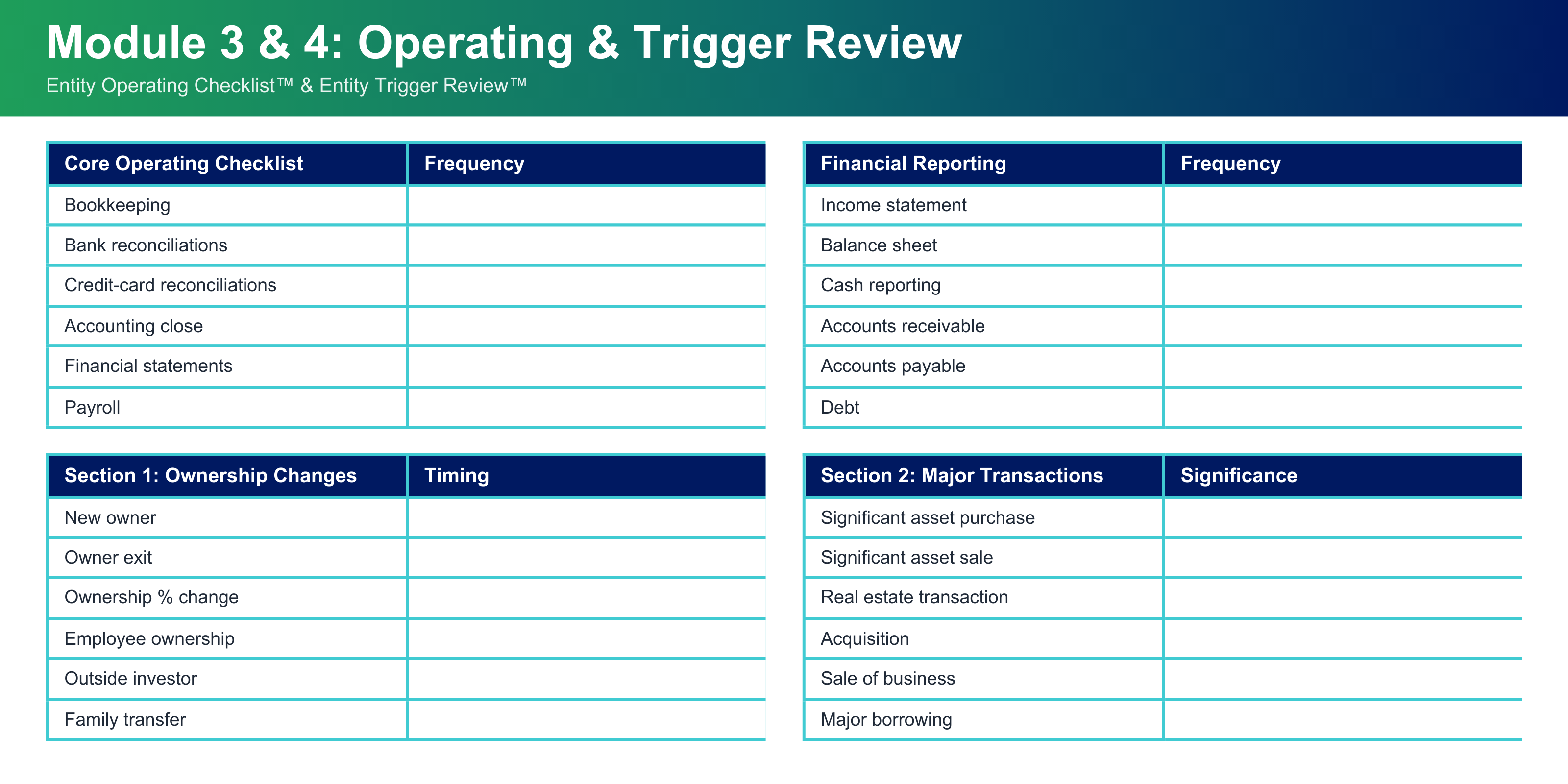
Formation is an event. Operation is a system. Forming an entity doesn’t mean the work is finished. Books need to be maintained. Bank accounts need to be reconciled. Financial statements need to be prepared and reviewed. Owner transactions need to be understood. Payroll needs to operate appropriately where applicable. Filings need to happen. Important records need to remain accessible. And someone needs to know when those things don’t happen. You aren’t going to become the company’s bookkeeper, payroll specialist, CPA, or attorney. Instead, you’ll establish visibility around what needs to happen, who owns it, when it happens, evidence it happened, review of the result, and escalation when it doesn’t.
Your Exception List™ identifies important responsibilities, records, financial processes, or reporting that isn’t operating the way you believe it should.
Entity Operating Checklist™ + Exception List™
I know how the entity is being operated and how I know the important work is getting done.
Formation Is an Event. Operation Is a System.
Hiring capable professionals and employees does not eliminate management responsibility. You don’t have to perform every task yourself. You need an appropriate system for knowing that the important work is happening.
Know When the Business Has Changed Enough to Ask Again
When should a business owner reconsider the assumptions behind an existing entity?
When something meaningful changes. Your entity was created around a set of facts. Then your business evolved. Maybe ownership changed, a partner is being considered, an employee may receive equity, an outside investor is interested, you’re acquiring significant real estate, you’re considering another business acquisition, a major asset may be sold, the company entered a new activity or jurisdiction, profitability changed materially, capital requirements changed, succession became relevant, retirement entered the conversation, or a company sale became possible. None of those automatically means the entity should change. They are triggers to ask whether the assumptions behind the existing structure deserve another conversation.
Classify issues with your Trigger Dashboard™:
Entity Trigger Review™ + Trigger Dashboard™
I recognize when something has changed enough to bring my advisers into the conversation before I act.
Why Didn’t My CPA Tell Me That?
Did I have the right professional, working within the right scope, with the right information, involved early enough to advise me?
It’s a question business owners ask all the time. Sometimes the professional should have raised the issue. Sometimes the owner assumed services were being provided that weren’t within the agreed scope. Sometimes the CPA didn’t know management was considering a consequential decision. Sometimes the question belongs primarily to another professional. And sometimes several advisers each understand one piece of the issue without anyone connecting the pieces. Your CPA isn’t sitting in every management meeting. Neither is your attorney. They may not know you’re considering an acquisition, selling a property, bringing in another owner, or planning your eventual exit unless someone tells them. Course 3B introduces an important advisory principle: Give Advisers Decisions, Not Just Documents.
You build:
Strategic Advisor Conversation Guide™
I know how to put the right expertise around an important decision while there’s still a decision to make.
Episode 5: When Complexity Hides the Truth
Before asking “Why didn’t my CPA tell me that?” ask: Did the right professional know what I was considering early enough to help me make the decision?
Listen to EpisodeA Trigger Is Not a Recommendation
A new owner doesn’t automatically mean a new entity. More profit doesn’t automatically mean changing tax classifications. A significant new activity doesn’t automatically require another LLC. A trigger tells you when to ask the question, not what the answer should be.
How Does Entity Owner’s Playbook™ Fit Into the System of Money™?
Entity Owner’s Playbook™ is part of a larger business operating framework. The System of Money™ examines how economics, information, decisions, leadership, and capital work together to create business performance and long-term enterprise value. Course 3B strengthens three connected pillars of that system: Visibility. Control. Stewardship.
Do You Actually Know What Is Happening Inside the Entity You Own?
Visibility means being able to see the financial and operating reality of the business clearly enough to make better decisions. For an entity owner, that starts with facts. What entity did you actually create? How is it treated for tax purposes? Who owns it? Which returns are being filed? Where are the governing documents? How are owner transactions being handled? Are the accounting records current? Are the bank accounts reconciled? Are financial statements being reviewed? Who owns recurring responsibilities? And how do you know the work is actually completed? Course 3B creates that visibility through your Entity Identity Card™, Entity Transaction Map™, Entity Operating Checklist™, and Exception List™. This is why Course 3B doesn’t stop at “My CPA handles it.” The more useful owner question is: “What is supposed to be happening, who owns it, and how do I know it’s happening?”
The underlying course specifically moves the owner from knowing who performs work to creating visibility into whether important responsibilities are actually being completed.
Do You Know When a Decision Requires Action Before It Becomes a Consequence?
Control does not mean knowing every tax rule or personally approving every transaction. It means understanding enough about the business to recognize where management action can change the outcome. For an entity owner, that includes recognizing when money moves between the business and an owner, owner compensation changes, a significant distribution is being considered, an owner or related-party loan changes, a material asset may be purchased or sold, ownership may change, outside capital is being considered, a consequential transaction is approaching, or a recurring operating responsibility isn’t being completed. Course 3B develops the habit of asking: What are we actually doing? Which entity is doing it? What could this affect? Who needs to be involved before we act? The objective isn’t to calculate every consequence yourself. It’s to recognize the decision while you can still influence it.
The owner does not become the tax preparer, but learns to recognize when entity-specific rules matter enough to ask before acting.
Are You Managing Today’s Entity With Tomorrow’s Business in Mind?
Stewardship asks whether today’s decisions are strengthening the enterprise you’re trying to build. Your entity was created around a set of facts. Then the business changes. A new owner may enter. An investor may become interested. The company may acquire real estate. A new business line may emerge. Capital needs may change. Succession may become important. You may begin considering an acquisition or eventual sale. Those changes don’t automatically mean the entity should change. They mean the assumptions underneath it may deserve another conversation. Course 3B explicitly teaches timely reconsideration rather than continuous restructuring. That is stewardship. The owner develops the ability to ask: “Has something changed enough that we should reconsider the assumptions behind our existing structure before we make the next decision?” Then: “Which expertise belongs around that decision?”
Module 5 brings that responsibility back to the owner: individual advisers may own pieces of the analysis, but the owner ultimately owns the business decision.
Your 90-Day Roadmap™
Don’t Just Take the Course. Implement It.
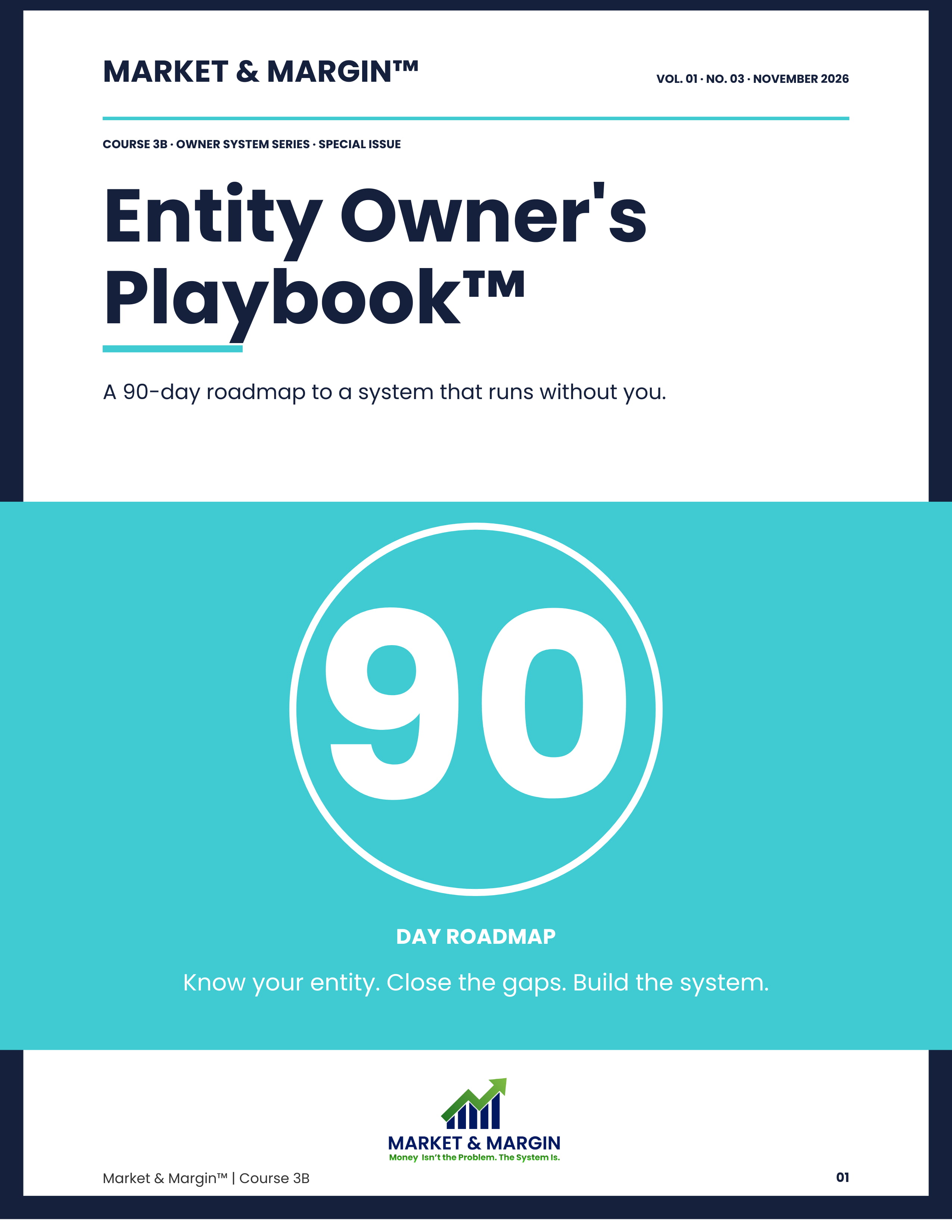
Your Course 3B purchase includes a 90-Day Roadmap™ designed to help you move from learning to implementation. The purpose isn’t to watch five modules in 90 days. The purpose is to build and begin using your Entity Owner’s Playbook™ in 90 days.
Know What You Own
Complete Modules 1 and 2.
Build
Identify
Establish Operating Visibility
Complete Module 3.
Build
Identify
Build Foresight and Advisory Discipline
Complete Modules 4 and 5.
Build
Identify
At Day 90
You should have more than course knowledge. You should have a working owner-level system you can continue using as the company evolves.
90-Day Roadmap™ included with Course 3B.
Entity Architecture Toolkit™
Want to Go Deeper Into the Architecture?
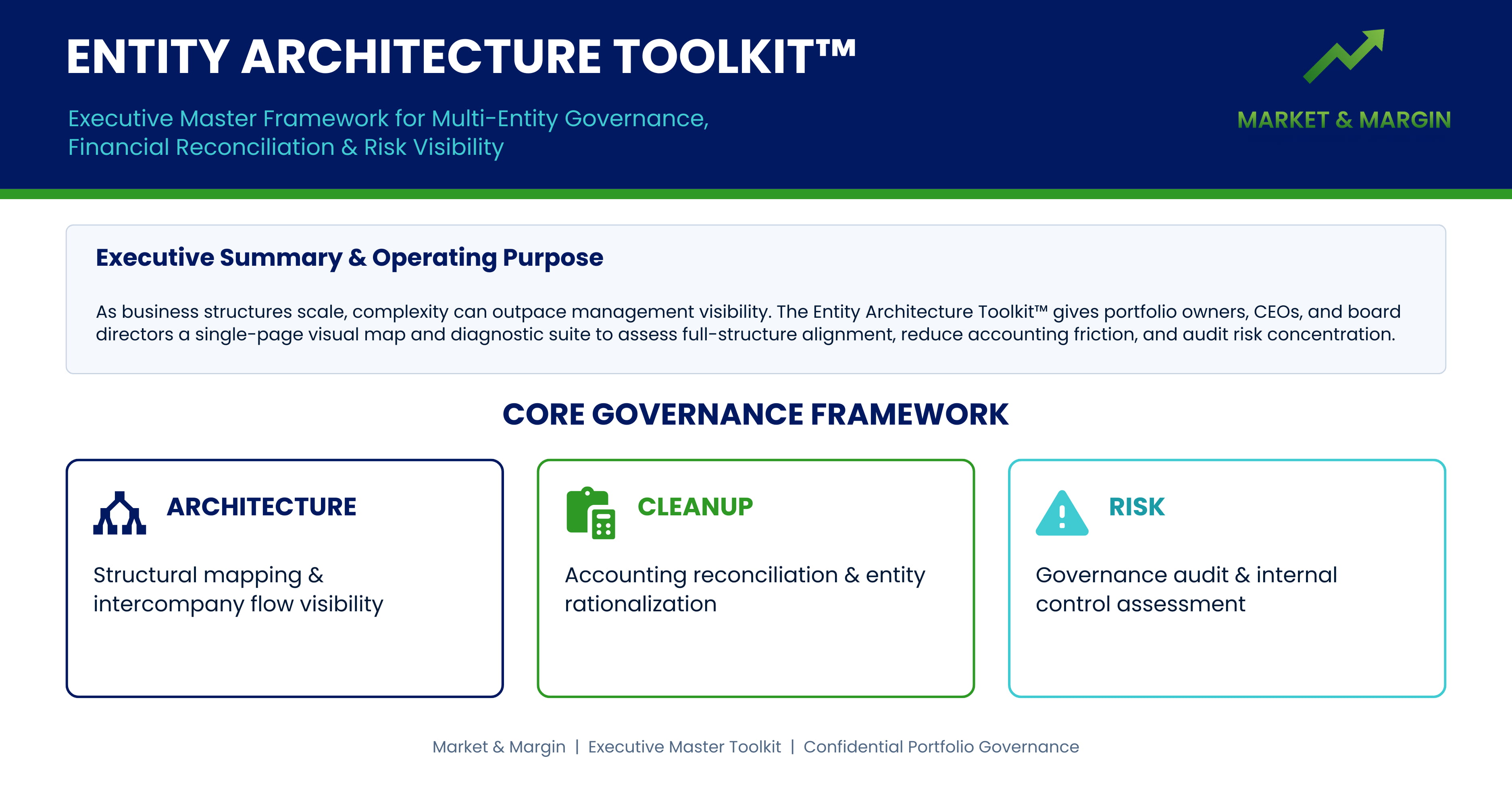
The Entity Architecture Toolkit™ is an optional companion implementation resource available for purchase with Course 3B only. It is separate from the Entity Owner’s Playbook™ included with your course.
Included with Course 3B: Entity Owner’s Playbook™
Your primary course implementation system.
Optional Add-On: Entity Architecture Toolkit™
Additional implementation tools for owners who want to go deeper into mapping and organizing their entity architecture.
What’s Included With Course 3B?
5-Module Entity Owner’s Playbook™ Course
Implementation-focused education designed around your business.
Entity Owner’s Playbook™
Your primary course deliverable, built throughout the five modules.
90-Day Roadmap™
A structured implementation path to help you complete the tools and put the Playbook to work.
Our Implementation Promise
Protection tied to actual completion and implementation of the course requirements.
Entity Architecture Toolkit™
Optional companion implementation toolkit.
Our Implementation Promise
If you complete the first three modules, submit all required exercises, and can honestly demonstrate that the frameworks did not enable you to gain greater clarity, better decision-making capability, or a more effective operating model, we’ll refund your investment. Complete within 90 days of purchase.
Who Is Entity Owner’s Playbook™ For?
Course 3B is designed for an established business owner who already has an entity and wants to understand and manage it more intelligently. It may be right for you if:
You say “I’m an LLC” or “I’m an S corporation” but aren’t completely sure how those terms fit together.
Your CPA, attorney, bookkeeper, or other professionals handle much of the entity work and you aren’t sure what you should understand yourself.
You can’t immediately locate important governing, election, ownership, or tax records.
You receive wages, distributions, draws, reimbursements, loan repayments, or other owner payments.
You’ve loaned money to your business or borrowed from it.
Your company owns significant assets.
You operate multiple related entities.
You’re considering changing ownership.
You’re considering a major asset purchase or sale.
Outside capital may become relevant.
Succession has entered the conversation.
Your business is materially larger or more complex than the company that existed when its entity was originally formed.
You’ve ever asked: “Why didn’t my CPA tell me that?”
Is Entity Owner’s Playbook™ a Tax Course?
No. Tax matters because the entity and facts surrounding a transaction may affect the consequences. But Course 3B does not teach you to prepare tax returns, calculate every tax outcome, or replace your CPA.
It develops: Owner Recognition. Not Owner Tax Preparation.
You are learning to recognize: \u201cMy entity may matter here. I don’t know the technical answer. We should understand it before we act.\u201d That’s not a lack of sophistication. That’s good ownership.
Does Course 3B Replace My CPA or Attorney?
No. It should make you better at using them. Your professionals bring expertise within their respective disciplines. You bring something they don’t automatically possess: the full context of what’s changing inside your business and the decisions you’re considering next.
The strongest advisory relationships bring those two things together early enough to matter.
Course 3A or Course 3B? Where Should You Start?
Course 3A: Entity Strategy Foundations™
Businesses evolve. Ownership changes. Assets accumulate. Capital requirements develop. Risk changes. New activities emerge. Future objectives become clearer. Course 3A helps you ask: Does the structure we started with still support the business we’ve built and the business we’re trying to build next? 3A evaluates the architecture.
Explore Entity Strategy Foundations™Course 3B: Entity Owner’s Playbook™
Once the entity exists, another set of responsibilities begins. Do you understand what you own? Which entity-specific issues may affect transactions? Whether operating responsibilities are being completed? What changes deserve professional review? When professional advisers need to become involved? Whether you’re giving advisers information early enough to affect the decision? 3B helps you own the architecture intelligently.
3A Helps You Evaluate It. 3B Helps You Own It.
You do not need to complete Course 3A before Course 3B unless you choose to establish that as a formal prerequisite. They solve related but different business-owner problems.
What Does Good Proactive Advice Require?
Scope
What did you actually hire the adviser to do?
Information
What does the adviser know about your business today?
Timing
Do they learn about the decision while you’re considering it or after you’ve made it?
Questions
What are you actually asking them to help evaluate?
Coordination
Does the decision cross tax, legal, financial, ownership, risk, estate, or strategic disciplines?
Accountability
Who owns each technical question?
And ultimately: Who owns the business decision?
You do.
Your advisers provide expertise. You own the decision.
Continue the Series 3 Journey
Series 3: What Entity Type Is Best?
Explore the questions behind entity architecture, ownership, and business decisions.
Explore Series 3Course 3A: Entity Strategy Foundations™
Determine whether the structure still aligns with the business you’ve built and what it may need next.
Explore Course 3ACourse 3B: Entity Owner’s Playbook™
Build an operating system for becoming a more informed and capable owner of the structure you have.
Own the Entity More Intelligently.
You don’t need to know everything your CPA knows. You don’t need to know everything your attorney knows. You shouldn’t. You hired professionals because their expertise goes deeper than yours in their respective disciplines.
But you’re the owner. You know where you’re trying to go. You know which decisions are being contemplated. You know when the business is changing. And you’re ultimately responsible for making sure the right expertise reaches the right decision at the right time.
Know What You Own.
Recognize When the Rules Matter.
Build Operating Visibility.
Know When the Facts Have Changed.
Put the Right Expertise Around the Decision.
Entity Owner’s Playbook™
The goal isn’t to become the expert. The goal is to become the owner who knows when expertise is needed, where to find it, and how to use it well.
Entity Owner’s Playbook™ included • 90-Day Roadmap™ included • Implementation Promise
Important Note: Entity Owner’s Playbook™ is educational and is designed to help business owners prepare for informed conversations with qualified professional advisors. It does not provide legal, tax, accounting, investment, or financial advice and is not a substitute for advice based on your individual circumstances.
Need a Partner to Deploy It?
If you need practical help understanding your entity structure — not just the templates — Market & Margin works with a limited number of companies directly.
Explore AdvisoryFrequently Asked Questions
Start With the Podcast
These Series 3 episodes introduce the entity concepts you'll build into systems in Course 3B. Listen first, then go deeper.
Stop Looking for the Perfect Entity
Once you realize entity structure matters, it's easy to swing too far — researching LLCs, corporations, S elections, and holding companies, trying to design the perfect structure for a business that doesn't exist yet. The best first entity is the one whose rules you understand well enough to build a business inside of it.
The Hidden Cost of Complexity
Every entity layer, holding structure, and election adds a cost you rarely see on a bill — until it slows decisions, creates confusion, or blocks a transaction. Explore how complexity accumulates and when it has outgrown the business.
When Complexity Hides the Truth
The more complex your business becomes, the more visibility you need. Not less. When sophistication creates opacity, mistakes, weak professional work, and even fraud become harder for ownership to see.
Continue the Journey
Course 3A helps you prepare for better conversations with your professional advisors. Course 3B helps you understand and operate the entity you already have.
Entity Strategy Foundations™
Prepare for better conversations with your CPA, attorney, and financial advisor. Build an Entity Decision Scorecard™ from five interconnected tools that organize the context your advisors need.
Explore Course 3AWant to explore the full learning journey? View all courses →